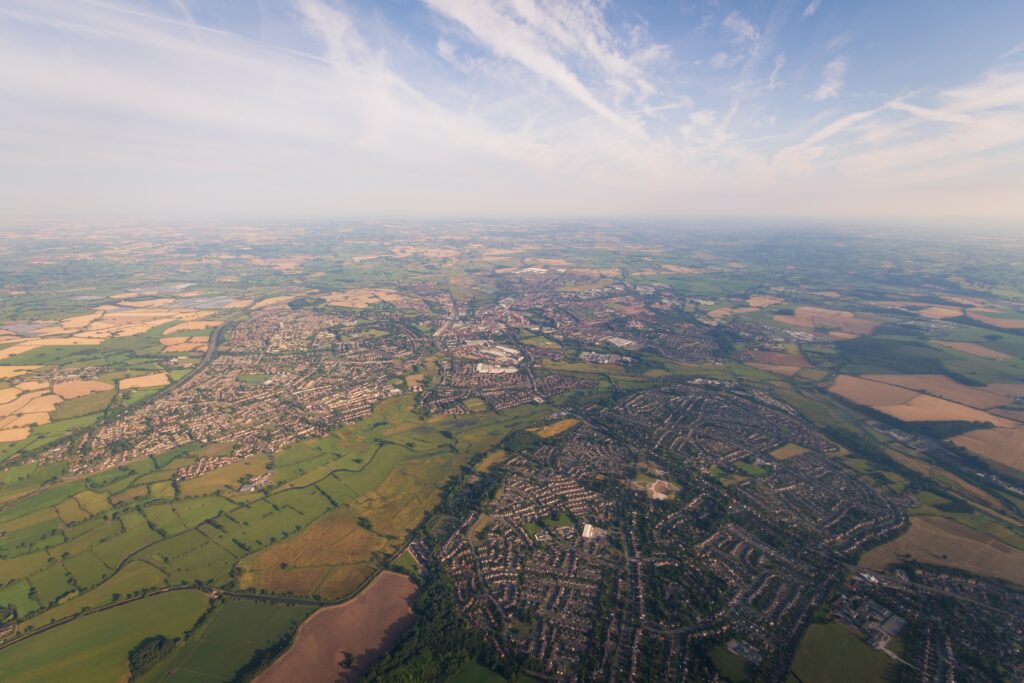
What is the Grey Belt?
In December 2024, the Labour government published their revised NPPF (we covered that here), introducing new policies relating to ‘Grey Belt’. This is a subset within the Green Belt land designation. Subject to compliance with specific conditions, land that meets the ‘Grey Belt’ definition may now be developed without being deemed as ‘inappropriate’. Together with the introduction of Grey Belt is the associated ‘Golden Rules’, which set out specific requirements for developments on Grey Belt land.
Grey Belt policy can apply to both commercial and residential developments and is aimed at helping the Labour government meet their target of 370,000 new homes per year, together with supporting that development with employment and associated infrastructure.
Grey Belt aims to enable development in areas of Green Belt which are not considered to be well-performing. Green Belt has long been considered to have an impact on housing supply in the UK. Our Director, Rob Rawlinson, considered this in his 2015 research paper, which you can read here.
Is there a definition of Grey Belt?
The NPPF gives a definition for Grey Belt as:
For the purposes of plan-making and decision-making, ‘grey belt’ is defined as land in the Green Belt comprising previously developed land and/or any other land that, in either case, does not strongly contribute to any of purposes (a), (b), or (d) in paragraph 143. ‘Grey belt’ excludes land where the application of the policies relating to the areas or assets in footnote 7 (other than Green Belt) would provide a strong reason for refusing or restricting development.
Grey Belt can therefore be broadly described as Green Belt that does not strongly contribute to: checking the unrestricted sprawl of large built-up areas; preventing neighbouring towns from merging; and preserving the setting and special character of historic towns, subject to other criteria.
The Grey Belt gains momentum
Since the NPPF 2024 introduced Grey Belt, the revised Green Belt Planning Practice Guidance (PPG) has formalised its application. Local authorities are now required to assess whether land meets the Grey Belt criteria, including previously developed sites or land that weakly contributes to core Green Belt purposes. Crucially, developments on such land that pass the NPPF’s paragraph 155 and adhere to the “Golden Rules” may now be deemed not inappropriate, bypassing the “very special circumstances” requirement.
As councils reassess their Green Belt boundaries, digital tools like LandInsight are gaining traction for identifying potential Grey Belt sites efficiently, helping developers stay steps ahead in a moving policy landscape.
What does the data say?
Planning decisions remain inconsistent, with examples demonstrating both ends of the spectrum. In St Albans, large-scale housing schemes on Grey Belt land have been approved, while in Beaconsfield, a 120-home development was rejected despite physical constraints suggesting otherwise. Such disparities reinforce that site-by-site judgment remains key.
New analysis from Marrons (May 2025) reveals that approximately 36% of housing appeals on Grey Belt land have been approved. They also suggest that, under the new criteria, the volume of “acceptable” Green Belt sites could treble in local plans, from 15% under the previous NPPF, to 60% under the new version.
Should developers remain cautious?
Planning law specialists suggest the new guidance will hasten the flow of Grey Belt applications. Since its introduction, multiple appeals have overturned refusals on this basis. Appeal success rates and increasing numbers of acceptable sites suggest momentum is growing. Yet, inconsistent case law, concerns over weakened affordability thresholds, and blurred environmental protections mean the policy’s full potential is still uncertain.
A parliamentary inquiry led by the Built Environment Committee warns that the policy could be rendered marginal if it competes with other overlapping planning reforms and lacks clear tracking and accountability mechanisms. Revisions to affordable housing obligations now require Grey Belt schemes to provide 15% more affordable homes than local policy requirements, capped at 50%, which may result in viability consequences to new development schemes.
CPRE (Campaign to Protect Rural England) has also cautioned that vaguely defined Grey Belt classifications risk encroaching on vital farming land, particularly near cities where nearly 11% of farmland lies within Green Belt boundaries
How can Acland Bracewell help?
If you consider you have land that may meet the definition of Grey Belt, get in touch. One of our expert team can provide you with advice in relation to development potential.